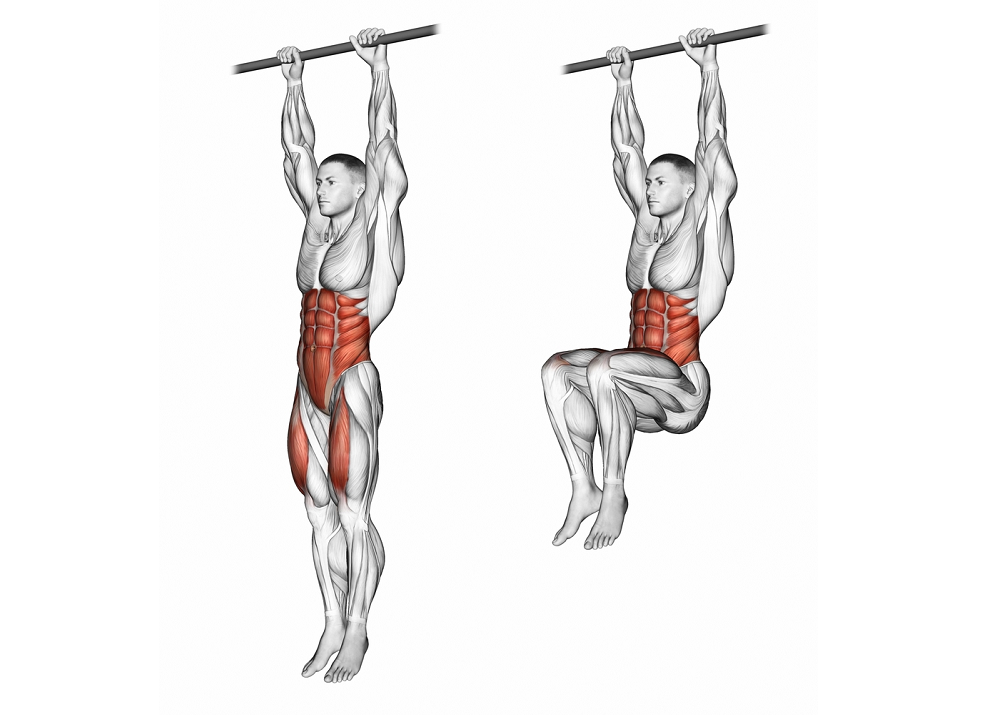
The hanging leg raise is often thought of as an abdominal exercise, but its biomechanics tell a more complete story. While the abdominal muscles play an important stabilizing role, the primary movement is produced by the hip flexors.
Understanding the anatomy and biomechanics of the hanging leg raise helps exercisers improve technique, appreciate the roles of the muscles involved, and develop greater movement awareness.
Primary Joint Action During the Hanging Leg Raise
The primary joint action performed during the hanging leg raise is:
- Hip flexion
As the legs are raised toward the torso, the hip flexor muscles produce the movement while the trunk muscles stabilize the pelvis and spine.
During the lowering phase, these same muscles work together to control the descent and maintain proper body alignment.
Prime Movers Involved in the Hanging Leg Raise
Iliacus
The iliacus is one of the primary hip flexors responsible for raising the thighs during the exercise. It produces much of the force required for hip flexion.
Psoas Major
The psoas major works together with the iliacus to flex the hip while also contributing to stabilization of the lumbar spine during movement.
Although frequently referred to together as the iliopsoas, the iliacus and psoas major are two distinct muscles that function together as the primary hip flexors.
Rectus Femoris
The rectus femoris assists with hip flexion while also crossing the knee joint, contributing to coordinated movement throughout the exercise.
The Role of the Abdominal Muscles
The rectus abdominis is often mistakenly viewed as the primary mover during the hanging leg raise.
In reality, its primary role is to stabilize the pelvis and trunk, helping maintain body position while the hip flexors raise the legs.
This stabilization is essential for controlled, efficient movement.
Hanging Leg Raise Mechanics
The hanging leg raise requires coordinated movement between the hips, pelvis, trunk, and shoulders.
During the upward phase, the hip flexors contract concentrically to raise the legs.
During the lowering phase, they contract eccentrically to control the descent and resist gravity.
Throughout both phases, the trunk muscles help maintain pelvic position and spinal stability.
Common Technique Considerations
Effective hanging leg raise technique includes:
- Maintaining a controlled movement throughout the exercise
- Avoiding excessive swinging or momentum
- Keeping the trunk stable during both phases
- Raising the legs through a comfortable range of motion
- Controlling the lowering phase
These principles improve movement quality and exercise effectiveness.
Why the Hanging Leg Raise Is More Than an Abdominal Exercise
The hanging leg raise demonstrates the importance of understanding movement rather than simply identifying muscles.
While the abdominal muscles play an essential stabilizing role, the movement itself is driven primarily by hip flexion.
Recognizing this distinction helps exercisers better understand exercise biomechanics and muscle function.
The Exercise Classroom
The Exercise Classroom focuses on anatomical, biomechanical, and practical exercise education designed to improve movement understanding and exercise execution.
The Hanging Leg Raise lesson explores:
- Exercise execution
- Hip flexion mechanics
- Prime movers and muscle roles
- Muscle mechanics
- Biomechanical considerations
- Safety and injury prevention
- Proper technique
Related Content
Hanging Leg Raise Exercise Page
The Exercise Classroom: Hanging Leg Raise
Learn More
Learn More @ KinX Learning
Anatomical, Biomechanical and Practical Exercise Education