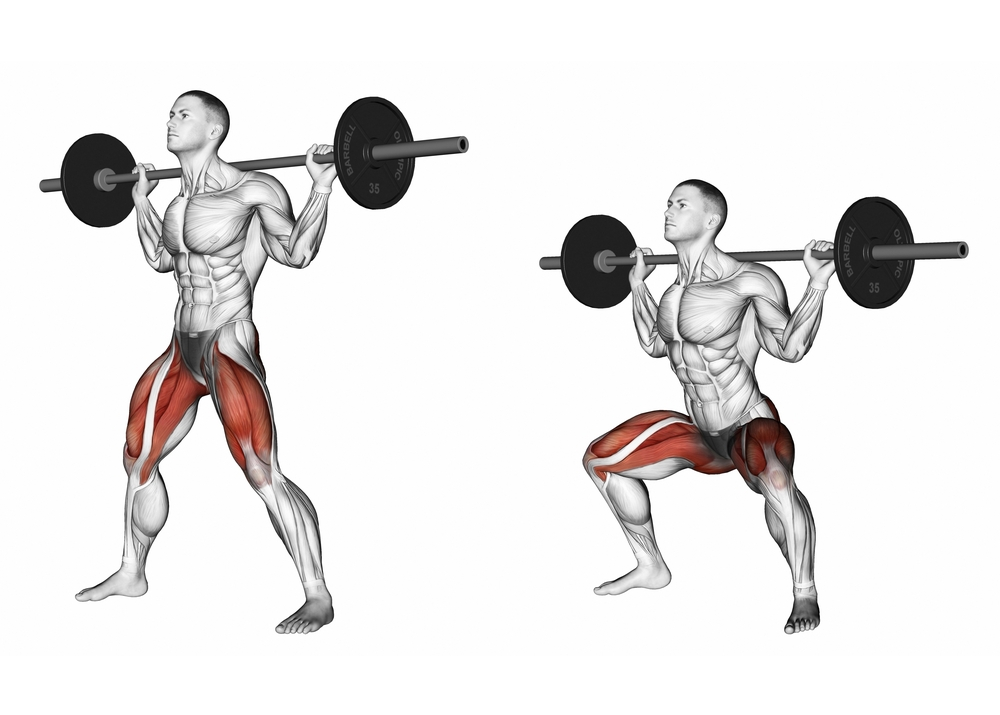
The squat is one of the most fundamental resistance exercises for developing lower-body strength and improving movement quality. More than simply a leg exercise, the squat demonstrates how multiple joints and muscles work together to produce coordinated, efficient movement.
Understanding squat mechanics helps exercisers improve technique, recognize the roles of key muscle groups, and develop a greater appreciation for the biomechanics behind one of the most widely performed strength-training exercises.
Primary Joint Actions During the Squat
The squat primarily involves two coordinated joint actions:
- Hip extension
- Knee extension
During the upward phase of the movement, the hips and knees extend simultaneously to raise the body back to the starting position. During the lowering phase, these joints flex in a controlled manner to position the body for the next repetition.
Proper coordination between these joint actions is essential for efficient movement and effective force production.
Prime Movers Involved in the Squat
Gluteus Maximus
The gluteus maximus is the primary hip extensor and plays a major role in producing force during the upward phase of the squat. Its contribution increases as the hips move from the bottom position toward full extension.
Quadriceps
The quadriceps extend the knees and are responsible for producing much of the force needed to stand up from the squat. All four quadriceps muscles contribute to knee extension throughout the movement.
Adductor Magnus
Although often associated with hip adduction, the posterior fibers of the adductor magnus also contribute to hip extension, particularly during the ascent from deeper squat positions.
Squat Mechanics
The squat is a compound movement requiring coordinated motion at the hips, knees, and ankles.
During the descent, the lower-body muscles work eccentrically to control the body's downward movement. During the ascent, the same muscles contract concentrically to return the body to a standing position.
Maintaining balance throughout the movement requires coordinated activation of the trunk and hip stabilizers while the center of mass remains over the base of support.
Common Technique Considerations
Effective squat technique includes:
- Maintaining a neutral spine throughout the movement
- Keeping the feet firmly planted on the floor
- Controlling both the descent and ascent
- Allowing the hips and knees to move together naturally
- Using a comfortable range of motion while maintaining proper alignment
These principles help improve movement quality, exercise effectiveness, and consistency.
Why the Squat Is a Foundational Exercise
The squat develops more than lower-body strength. It teaches coordinated movement, balance, stability, and force production across multiple joints.
Because it closely resembles movements performed in everyday life—such as sitting, standing, and lifting—the squat is often considered one of the foundational patterns in resistance training and functional movement.
The Exercise Classroom
The Exercise Classroom focuses on anatomical, biomechanical, and practical exercise education designed to improve movement understanding and exercise execution.
The Squat lesson explores:
- Exercise execution
- Hip and knee extension mechanics
- Prime movers and muscle roles
- Muscle mechanics
- Biomechanical considerations
- Safety and injury prevention
- Proper technique
Related Content
Deadlift Mechanics: Understanding the Hip Hinge
The Exercise Classroom: SquatKinX Learning
Learn More
Learn More @ KinX Learning
Anatomical, Biomechanical and Practical Exercise Education