
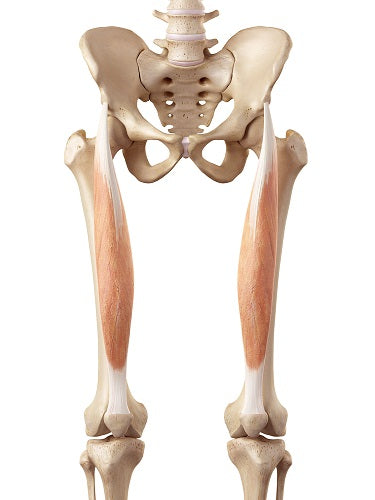
Muscle Anatomy
rectus femoris
The rectus femoris muscle is situated in the anterior compartment of the thigh. It is one of the quadriceps muscles, contributing to the overall musculature of the front of the thigh. It is the central and largest muscle of the quadriceps group.
Origin:
Originating from the anterior inferior iliac spine and the acetabulum of the hip bone, the rectus femoris takes its starting point from the bony structures of the pelvis.
Insertion:
The muscle inserts into the patellar tendon and, subsequently, into the base of the patella (kneecap). From there, the patellar tendon continues and attaches to the tibial tuberosity. This insertion site establishes a connection with the patella and the tibia.
Function:
Functionally, the rectus femoris is a powerful knee extensor. It plays a key role in straightening the knee joint, as seen in activities like standing up from a seated position, walking, and running. Additionally, the muscle is involved in hip flexion, lifting the thigh toward the torso. The rectus femoris is integral to the coordinated movements of the lower limb and is particularly active during various phases of the gait cycle.
rectus femoris
Related Exercises
The rectus femoris is most active during knee extension and contributes to hip flexion. Exercises that emphasize controlled knee extension and proper lower body mechanics are most effective for targeting this muscle.
Related Exercises for the Rectus Femoris
Primary Isolation Exercise
Knee Extension (Leg Extension)
Compound Exercises
Squat
Machine Squat
Leg Press
Functional and Unilateral Movements
Lunge
Side Lunge
How to Emphasize the Rectus Femoris
To increase rectus femoris activation during exercise:
Focus on straightening the knee completely during each repetition
Maintain an upright position to reduce glute dominance
Control both the lifting and lowering phases
Avoid excessive weight or swinging that reduces muscle
engagement
Explore Exercise Technique and Execution
Each exercise listed above includes a full breakdown of proper form, muscle involvement, biomechanics, and safety considerations. Select an exercise to learn how to train the rectus femoris effectively.