Introduction
The lunge is one of the most effective lower-body exercises for developing strength, balance, and functional movement. Unlike bilateral exercises such as the squat, the lunge trains each leg independently, helping improve muscular balance, coordination, and stability while strengthening the muscles used in everyday activities and athletic performance.
Muscles Worked During the Lunge
Primary Movers
- Gluteus Maximus
- Quadriceps
- Hamstrings
Synergists
- Gluteus Medius
- Adductor Magnus
- Soleus
Stabilizers
- Abdominal Muscles
- Erector Spinae
- Hip Abductors
- Hip Adductors
- Triceps Surae
Joint Actions
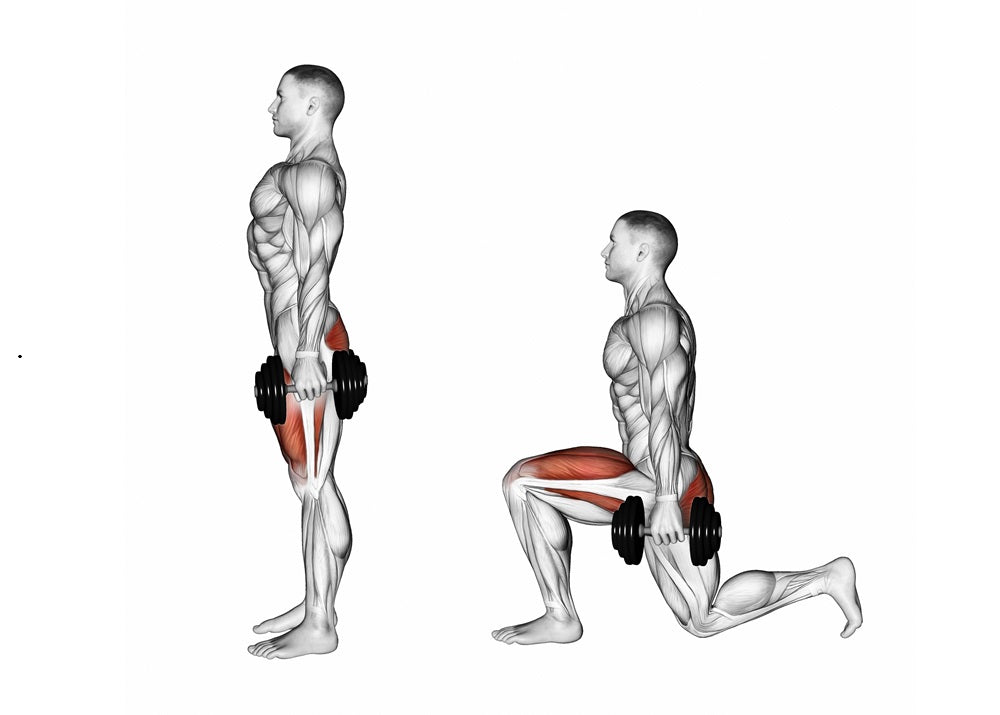
The lunge primarily involves hip and knee flexion during the lowering phase, followed by hip and knee extension during the upward phase. The ankle also moves through controlled dorsiflexion and plantar flexion while the trunk and pelvis remain stable throughout the exercise.
Functional Benefits
The lunge develops unilateral lower-body strength while improving balance, coordination, and movement control. Because each leg works independently, lunges help identify and correct strength imbalances while enhancing stability during walking, running, stair climbing, and many athletic movements.
Body Contour Benefits
Lunges effectively develop the gluteals, quadriceps, and hamstrings, contributing to stronger, more defined lower-body musculature. They also engage numerous stabilizing muscles throughout the hips and core, promoting balanced muscular development.
Biomechanical Considerations
- Proper step length helps maintain efficient lower-body alignment.
- Keeping the torso upright improves balance and movement efficiency.
- The front leg performs most of the work during the upward phase.
- Controlled movement enhances muscle activation and joint stability.
Proper Technique
Begin by standing tall with your feet hip-width apart. Step forward into a comfortable stride while maintaining an upright posture. Lower your body until both knees are bent to approximately 90 degrees, keeping your front knee aligned over your foot. Push through the front foot to return to the starting position while maintaining balance and control throughout the movement.
Common Technique Errors
- Taking too short of a step.
- Allowing the front knee to collapse inward.
- Leaning the torso excessively.
- Pushing primarily with the back leg instead of the front leg.
Safety and Injury Prevention
Use a controlled range of motion while maintaining proper knee and hip alignment. Avoid excessive forward knee movement if it causes discomfort, and keep the core engaged to stabilize the trunk throughout the exercise. Start with body weight before progressing to external resistance.
Conclusion
The lunge is an outstanding exercise for developing lower-body strength, balance, stability, and functional movement. By understanding the anatomy, biomechanics, and proper technique behind the movement, you can perform lunges more effectively while improving performance and reducing injury risk.
Related Content
Lunge Exercise Page Gluteus Maximus Muscle Page
Quadriceps Muscle Page
Hamstrings Muscle Page
Hip Adductors Muscle Page
Iliacus Muscle Page
Psoas Major Muscle Page