
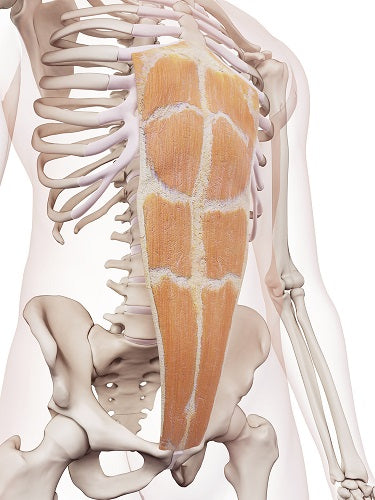
Muscle Anatomy
The rectus abdominis muscle is located in the anterior aspect of the abdomen and is commonly known as the "six-pack." It is a long and flat muscle that extends vertically along the midline of the abdomen.
Origin:
Originating from the pubic symphysis and the pubic crest, the rectus abdominis takes its starting point from the bony structures at the front of the pelvis.
Insertion:
The muscle inserts into the costal cartilages of the fifth, sixth, and seventh ribs, as well as into the xiphoid process of the sternum. This insertion site establishes a connection with the lower ribs and the sternum.
Function:
Functionally, the rectus abdominis is a key muscle for trunk flexion. It contracts to bend the spine forward, bringing the ribcage closer to the pelvis. Additionally, the muscle contributes to the stabilization of the pelvis and the maintenance of posture. While often associated with aesthetic considerations due to its prominence, the rectus abdominis plays a vital role in core stability and the mechanics of various movements, such as sitting up from a lying position.
rectus abdominis
Related Exercises
Best Exercises for the Rectus Abdominis
The rectus abdominis is the primary abdominal muscle responsible for trunk flexion and plays a key role in core stability. Exercises that emphasize controlled spinal flexion and abdominal contraction are most effective for targeting this muscle.
Primary Isolation Exercises
Abdominal Machine Crunch
Sit-Up (Curl-Up)
Supporting Movements
Hanging Leg Raise
Reverse Sit-Up
How to Emphasize the Rectus Abdominis
Focus on curling the torso rather than pulling with the neck or hips
Engage the abdominals before initiating movement
Avoid using momentum during repetitions
Control both the lifting and lowering phases to maintain tension
Explore Exercise Technique and Execution
Each exercise listed above includes a full breakdown of proper form, muscle involvement, biomechanics, and safety considerations. Select an exercise to learn how to train the core effectively.