
Muscle Anatomy
ADDUCTOR MAGNUS
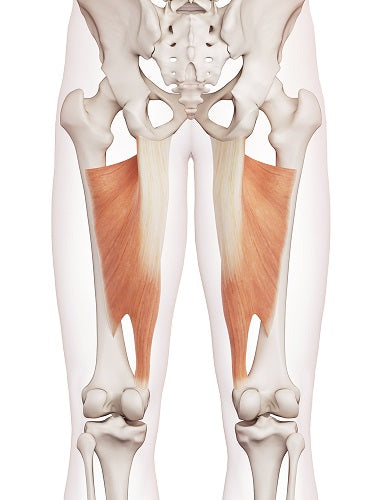
The adductor magnus, a robust thigh muscle, orchestrates hip and thigh movements through its distinct parts.
Origin:
The adductor part arises from the inferior pubic and ischial rami, blending with adductor longus and brevis. Simultaneously, the hamstring part originates from the ischial tuberosity, aligning with the hamstrings.
Insertion:
The adductor part inserts into the femur's linea aspera, extending to the medial supracondylar line. The hamstring part merges with hamstring tendons and inserts into the adductor tubercle on the femur.
Function:
The adductor part primarily governs hip adduction, crucial for bringing the thigh toward the midline and stabilizing the hip during weight-bearing activities. Simultaneously, the hamstring part contributes to hip extension, aids in knee flexion, and complements the adductor part's role in hip adduction and overall limb stability.
Adductor Magnus
Related Exercises
The adductor magnus is the largest of the adductor muscles and contributes to both hip adduction and hip extension, playing a key role in powerful lower body movements.
Primary Isolation Exercises
Hip Joint Adduction
Compound Exercises
Squat
Deadlift
Supporting Movements
Lunge
Side Lunge
How to Emphasize the Adductor Magnus
Focus on controlled inward movement of the legs during adduction
Engage the inner thighs during both lowering and lifting phases
Maintain proper hip positioning to avoid shifting load away from the adductors
Control the movement to maintain tension throughout the exercise
Explore Exercise Technique and Execution
Each exercise listed above includes a full breakdown of proper form, muscle involvement, biomechanics, and safety considerations. Select an exercise to learn how to train the inner thigh effectively.