
Exercise Reference
Sit-up
The Sit-Up (Curl-Up) is a core exercise designed to strengthen the muscles responsible for trunk flexion, particularly the rectus abdominis. Performed by raising the torso from a supine position, the movement emphasizes controlled spinal flexion while maintaining stable lower-body positioning. Proper execution emphasizes smooth movement of the torso, controlled abdominal engagement, and stable positioning of the hips and feet throughout the exercise.
Below is a quick reference overview of the major muscles and joint actions involved in the Sit-Up (Curl-Up), followed by practical guidance for performing the exercise safely and effectively.
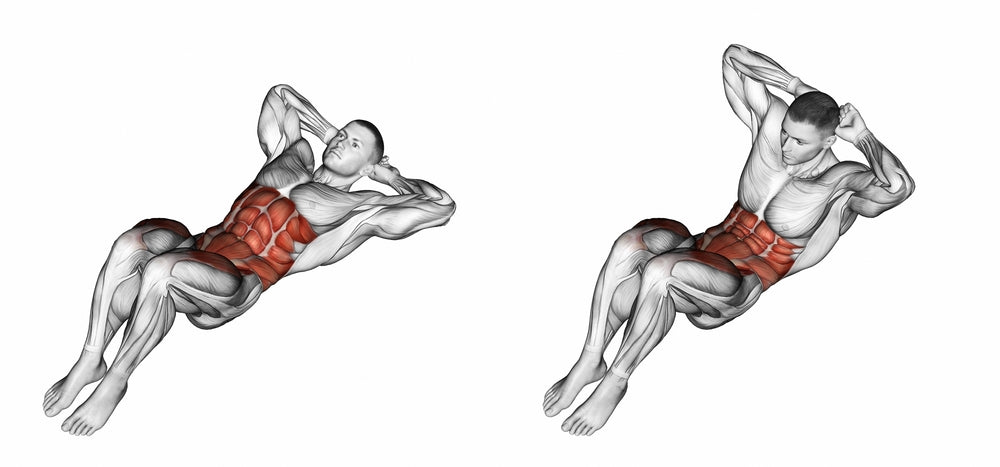
Joint Action and Muscles Involved
The Sit-Up, a quintessential abdominal exercise, revolves around the joint action of hip flexion. As you perform a Sit-Up, the hip joint flexes, bringing your torso towards your thighs.
Engaging in Sit-Ups primarily targets the muscles of the abdominal region. The rectus abdominis, commonly known as the "six-pack" muscles, contracts to flex the spine and bring the upper body towards the pelvis. Additionally, the external obliques and internal obliques, situated on the sides of the torso, play a supportive role in the twisting motion often associated with Sit-Ups.
Moreover, the hip flexors, including the iliopsoas, engage to facilitate the flexion of the hip joint during the upward phase of the Sit-Up. As a comprehensive core exercise, the Sit-Up effectively works these muscle groups, promoting strength and endurance in the abdominal region.
Exercise Execution
Starting Position
Lie on your back with the knees bent and the feet flat on the floor. Position the hands lightly behind the head or crossed over the chest. Keep the lower back in a neutral position and the abdominal muscles engaged.
Movement
Raise the torso by flexing the trunk and contracting the abdominal muscles. Continue lifting until the upper torso reaches an upright seated position or a controlled partial curl-up position.
Ending Position
Pause briefly at the top, then lower the torso under control back to the starting position while maintaining abdominal tension.
Video Demonstration
This video demonstrates the proper execution of the sit-up (curl-up), showing controlled trunk flexion, abdominal engagement, and stable lower-body positioning throughout the exercise.

Safety Considerations
Avoid pulling on the neck with the hands during the movement, as this can place unnecessary stress on the cervical spine. Focus on controlled abdominal contraction rather than using momentum to raise the torso. Maintain smooth movement throughout the exercise and stop if discomfort occurs in the lower back or neck.
Exercise Tps
Lead with the Abdominals
Initiate the movement by contracting the abdominal muscles rather than pulling with the neck or arms.
Control the Descent
Lower the torso under control to maintain tension on the abdominal muscles.
Keep the Neck Neutral
Avoid excessive forward bending of the neck during the movement.
Use a Comfortable Range of Motion
Raise the torso only as far as can be maintained with proper control and abdominal engagement.
Sit-Up vs Abdominal Machine Crunch
The Sit-Up (Curl-Up) and Abdominal Machine Crunch both strengthen the abdominal muscles, but they differ in how resistance and stabilization are applied. The Sit-Up is a bodyweight exercise that requires the torso to move freely while the lower body remains stable. In contrast, the Abdominal Machine Crunch uses external resistance and a guided path to isolate the abdominal muscles. Both exercises are effective for core development. The sit-up emphasizes bodyweight control, while the machine crunch allows progressive resistance.

Related Exercises

Continue Your Exercise Education
Mastering exercise technique requires a deeper understanding of biomechanics, injury prevention, and precise movement cues.
The KinX Learning Ultimate Guide series provides structured analysis of 75 popular weight training exercises, helping you train with greater confidence, efficiency, and safety.
Explore the complete system:
Exercise Anatomy and Biomechanics: Ultimate Guide
Exercise Safety and Injury Prevention: Ultimate Guide
Exercise Cues: Precision Coaching for 75 Essential Exercises
Or get all three guides together with the Ultimate Guides Bundle.