
Exercise Anatomy
ABDOMINAL MACHINE CRUNCH
he Abdominal Machine Crunch is an isolation exercise designed to strengthen the muscles responsible for trunk flexion, particularly the rectus abdominis. By using a guided abdominal crunch machine, the exercise allows controlled resistance while helping maintain stable body positioning throughout the movement. This makes it a practical option for developing abdominal strength while reducing the stabilization demands required in many free-weight core exercises.
Unlike many bodyweight abdominal movements that rely heavily on momentum or hip involvement, the abdominal machine crunch focuses on controlled spinal flexion through the abdominal musculature. When performed with proper technique and a full range of motion, the exercise effectively trains the muscles of the anterior core while reinforcing controlled movement of the torso.
Below is a quick reference overview of the major muscles and joint actions involved in the Abdominal Machine Crunch, followed by practical guidance for performing the exercise safely and effectively.
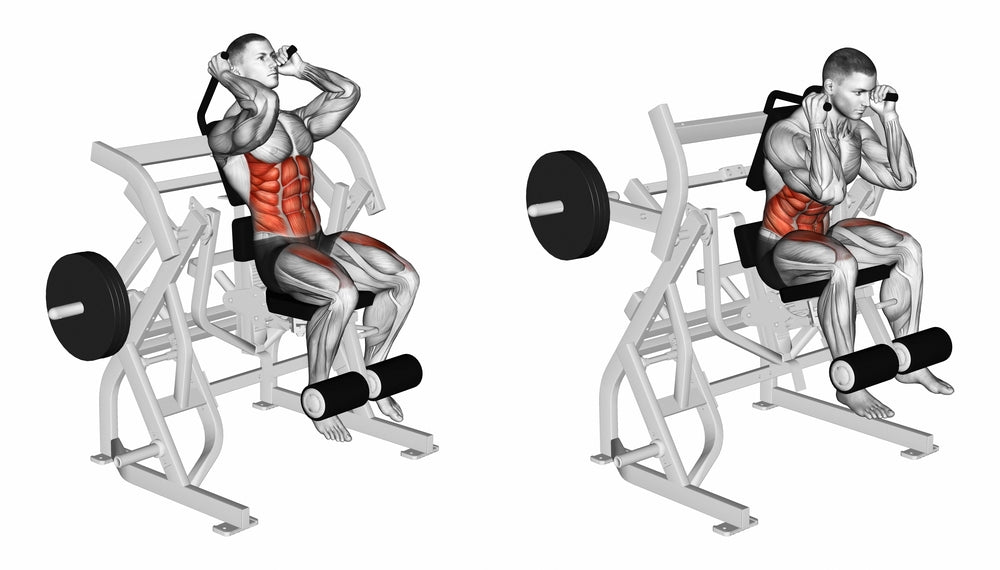
Joint Action and Major Muscles Involved
The Abdominal Machine Crunch primarily involves flexion of the spine. During this exercise, the main joint action is the flexion of the vertebral column, where the spine curves forward. The rectus abdominis, commonly known as the six-pack muscles, is the primary muscle engaged in this movement. Additionally, the exercise recruits the internal obliques and external obliques, which assist in the rotation of the trunk, contributing to the overall contraction and engagement of the core. As you crunch forward on the abdominal machine, these muscles work synergistically to contract and create the desired flexion, promoting abdominal strength and definition.
Exercise Execution
Starting Position
Sit on the abdominal crunch machine with your back firmly against the pad and your feet secured beneath the foot supports if provided. Position the shoulder pads or handles comfortably across your upper chest or shoulders according to the machine design. Maintain a neutral spine with your chest lifted and your abdominal muscles gently engaged before beginning the movement.
Movement
Initiate the exercise by contracting the abdominal muscles to flex the torso forward. Focus on drawing the rib cage toward the pelvis rather than pulling with the arms or shoulders. Perform the movement in a slow and controlled manner while keeping the hips stable against the seat. Avoid using momentum or excessive upper-body movement, allowing the abdominal muscles to control the entire motion.
Finish
Continue the forward motion until the torso reaches the end of its comfortable range of spinal flexion. Pause briefly at the contracted position while maintaining abdominal tension. Slowly return to the starting position under control, allowing the torso to move back to neutral without fully relaxing the abdominal muscles between repetitions.
Video Demonstration
This video demonstrates the proper execution of the abdominal machine crunch, emphasizing controlled spinal flexion and proper machine positioning.

Safety Considerations
The most important safety consideration during the Abdominal Machine Crunch is maintaining controlled spinal flexion while keeping the lower back and neck in a safe position. Begin by adjusting the machine so the pads fit comfortably against your upper body and your feet are securely positioned. Proper setup helps stabilize the body and allows the abdominal muscles to perform the work.
Focus on moving the torso through a slow and controlled range of motion, avoiding momentum or pulling with the arms if the machine includes handles. Select a resistance that allows you to maintain good form throughout the exercise.
If you experience pain or discomfort in the lower back or neck, stop the movement and reassess your positioning and resistance level. Proper control and appropriate weight are essential for performing the exercise safely and effectively.
Exercise TIPS
Focus on Controlled Spinal Flexion
The effectiveness of the Abdominal Machine Crunch depends on actively flexing the spine using the abdominal muscles. Concentrate on bringing the rib cage toward the pelvis rather than simply leaning forward with the shoulders. This helps ensure the rectus abdominis is performing the primary work.
Avoid Using Momentum
Perform the movement in a slow, controlled manner to maintain consistent muscular tension. Rapid or jerking motions reduce the involvement of the abdominal muscles and can place unnecessary stress on the spine and surrounding structures.
Maintain Stable Hip Position
Keep the hips and lower body firmly supported against the seat and pads during the exercise. Excessive hip movement can shift the workload away from the abdominal muscles and reduce the effectiveness of the exercise.
Use an Appropriate Resistance Level
Select a resistance that allows you to perform the movement with proper control and full range of motion. Excessive weight often leads to shortened movement patterns or reliance on upper body momentum rather than abdominal muscle contraction.
Coordinate Breathing with the Movement
Exhale as you contract the abdominal muscles and flex the torso forward, and inhale as you return to the starting position. Proper breathing helps maintain core engagement and improves movement control throughout the exercise.
Abdominal Machine Crunch vs Sit-Up
The Abdominal Machine Crunch isolates the abdominal muscles while supporting the torso with a machine. This allows controlled spinal flexion and reduces the involvement of the hip flexor muscles.
In contrast, the Sit-Up is a bodyweight exercise that involves both the abdominal muscles and the hip flexors. During a sit-up, the iliopsoas and other hip flexor muscles assist in lifting the torso, especially as the body moves toward a fully upright position.
Because the abdominal machine crunch minimizes hip flexor involvement and provides resistance through a controlled range of motion, it is often preferred when the goal is to focus on the abdominal muscles and reduce stress on the lower back.

Related Exercises
Anatomical, Biomechanical and Practical Exercise Education
The Exercise Classroom
The Exercise Classroom provides anatomical, biomechanical, and practical instruction for mastering exercise technique. Each lesson explains how muscles function during the movement, how joint mechanics influence performance, and how proper technique improves both safety and effectiveness.

Continue Your Exercise Education
Mastering exercise technique requires a deeper understanding of biomechanics, injury prevention, and precise movement cues.
The KinX Learning Ultimate Guide series provides structured analysis of 75 popular weight training exercises, helping you train with greater confidence, efficiency, and safety.
Explore the complete system:
Exercise Anatomy and Biomechanics: Ultimate Guide
Exercise Safety and Injury Prevention: Ultimate Guide
Exercise Cues: Precision Coaching for 75 Essential Exercises
Or get all three guides together with the Ultimate Guides Bundle.