
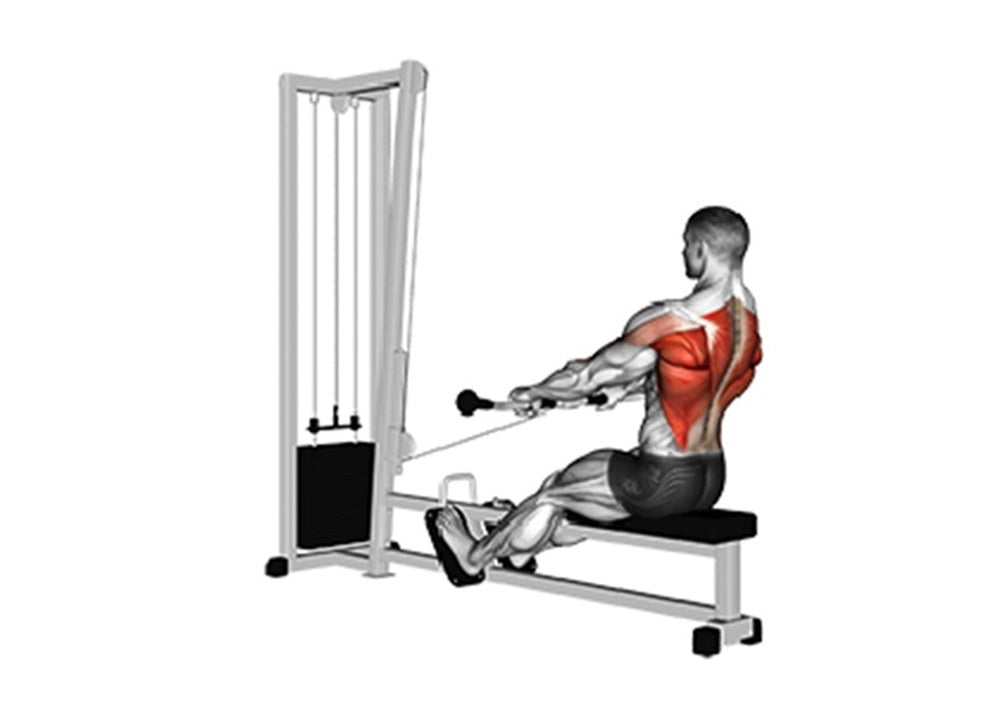
The seated row is one of the most effective resistance training exercises for developing the muscles of the upper back while improving posture, scapular control, and pulling mechanics. Although many people simply view the seated row as a “back exercise,” proper rowing mechanics involve coordinated movement between several muscle groups and joints.
Understanding the anatomy and biomechanics involved in the seated row can help improve exercise effectiveness, upper back activation, and overall movement quality.
Primary Joint Actions During the Seated Row
The seated row primarily involves:
-
Shoulder joint extension
-
Shoulder joint horizontal abduction
-
Scapular retraction
-
Elbow flexion
These joint actions occur together to produce the rowing movement while stabilizing the torso and maintaining proper posture.
Prime Movers Involved in the Seated Row
Latissimus Dorsi
The latissimus dorsi is one of the primary muscles involved in the seated row. This large muscle contributes to shoulder extension and shoulder adduction while helping pull the elbows backward during the rowing motion.
The lats also play an important role in controlling upper body positioning throughout the exercise.
Rhomboids
The rhomboids assist with scapular retraction, helping pull the shoulder blades together during the rowing movement.
Proper rhomboid activation contributes to upper back development and improved posture.
Middle Trapezius
The middle trapezius works alongside the rhomboids to stabilize and retract the scapulae.
This muscle plays an important role in maintaining upper back control and proper rowing mechanics.
Rear Deltoids
The rear deltoids assist with shoulder horizontal abduction during the rowing movement.
These muscles help move the upper arms backward while contributing to shoulder stability.
Importance of Scapular Movement
One of the most common seated row mistakes is performing the exercise primarily with the arms while minimizing scapular movement.
Proper rowing mechanics should involve coordinated scapular retraction and controlled elbow drive. Focusing on upper back movement instead of simply pulling with the arms can help improve muscle activation and exercise effectiveness.
Posture and Upper Back Control
Maintaining proper posture during the seated row is important for maximizing upper back involvement.
Key considerations include:
-
Maintaining a neutral spine
-
Keeping the chest lifted
-
Avoiding excessive torso swinging
-
Controlling the movement throughout the repetition
Using controlled movement instead of momentum can help improve muscular engagement while reducing unnecessary stress on the joints.
The Exercise Classroom
The Exercise Classroom focuses on anatomical, biomechanical, and practical exercise education designed to improve movement understanding and exercise execution.
The seated row lesson explores:
-
exercise execution
-
prime movers
-
muscle mechanics
-
biomechanical considerations
-
exercise effectiveness
-
proper technique
Related Content
The Exercise Classroom: Seated Row
Learn More
Learn More @ KinX Learning
Anatomical, Biomechanical and Practical Exercise Education

