
Exercise Reference
REVERSE SIT-UP
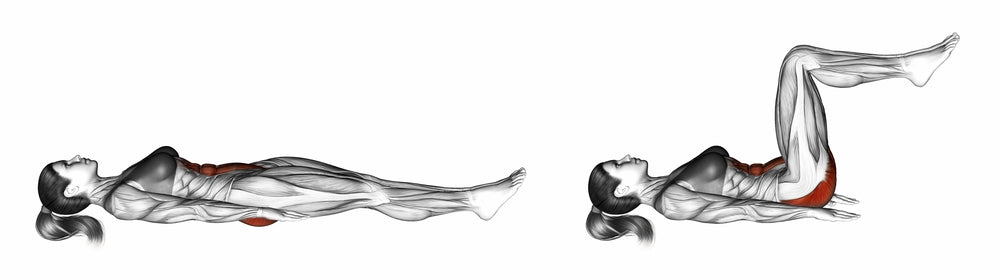
The Reverse Sit-Up is an isolation core exercise designed to strengthen the abdominal muscles through controlled trunk and hip flexion, with particular emphasis on the lower abdominal region. Performed by lifting the lower body toward the torso while maintaining upper-body stability, the movement helps improve core strength, pelvic control, and abdominal endurance. Proper execution emphasizes smooth movement, controlled lifting of the pelvis, and slow lowering throughout the exercise.
Joint Actions Involv and Muscles Involved
During a Reverse Situp, the primary joint action is hip flexion, where the angle between the thigh and the torso decreases. This movement engages the rectus abdominis, which is the primary muscle responsible for flexing the spine. Additionally, the exercise involves the activation of the hip flexors, including the iliopsoas, as they play a key role in lifting the legs toward the chest during the movement.
Viseo Demonstration
This video demonstrates the proper execution of the reverse sit-up, showing controlled trunk and hip flexion, stable upper-body positioning, and smooth movement throughout the exercise.
Exercise Tips
Lift Through the Abdominals
Focus on curling the pelvis upward using the abdominal muscles rather than swinging the legs.
Keep the Upper Body Stable
Maintain stable shoulder and upper-back contact with the floor or bench.
Control the Lowering Phase
Lower the legs and pelvis smoothly to maintain abdominal tension.

Safety Considerations
Avoid using momentum to lift the legs and pelvis, as this reduces abdominal engagement and can place unnecessary stress on the lower back. Keep the movement smooth and stop if discomfort occurs in the lower back, hips, or neck.

Related Exercises

Continue Your Exercise Education
Mastering exercise technique requires a deeper understanding of biomechanics, injury prevention, and precise movement cues.
The KinX Learning Ultimate Guide series provides structured analysis of 75 popular weight training exercises, helping you train with greater confidence, efficiency, and safety.
Explore the complete system:
Exercise Anatomy and Biomechanics: Ultimate Guide
Exercise Safety and Injury Prevention: Ultimate Guide
Exercise Cues: Precision Coaching for 75 Essential Exercises
Or get all three guides together with the Ultimate Guides Bundle.