
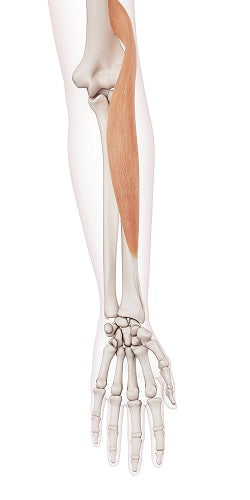
Muscle Anatomy
brachioradialis
The brachioradialis, a prominent forearm muscle, spans the proximal forearm, contributing to wrist and elbow movements.
Origin:
Arising from the lateral supracondylar ridge of the humerus, the brachioradialis has its attachment points along the humeral shaft.
Insertion:
The muscle inserts into the distal radius near the styloid process, providing leverage for forearm movements.
Function:
The brachioradialis functions as a versatile muscle, contributing to both elbow flexion and forearm supination. It is particularly active during activities like lifting and pulling, providing stability to the elbow joint and aiding in controlled movements of the forearm. As a biarticular muscle, it plays a crucial role in various functional tasks involving the coordination of the elbow and wrist joints.
Brachioradialis
Related Exercises
Best Exercises for the Brachioradialis
The brachioradialis is a forearm muscle that assists in elbow flexion, particularly when the forearm is in a neutral position. It plays an important role in controlled pulling and gripping movements.
Primary Isolation Exercises
Biceps Curl with a Barbell
Biceps Curl on a Machine
Supporting Movements
Chin-Up
Pull-up
How to Emphasize the Brachioradialis
Maintain a neutral or semi-neutral forearm position during elbow flexion
Focus on controlled movement rather than heavy loading
Avoid excessive wrist movement during the exercise
Control both the lifting and lowering phases to maintain tension
Explore Exercise Technique and Execution
Each exercise listed above includes a full breakdown of proper form, muscle involvement, biomechanics, and safety considerations. Select an exercise to learn how to train the arm muscles effectively.