
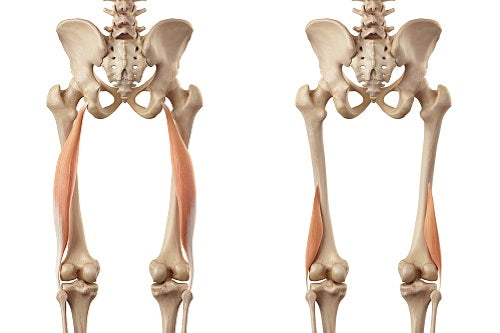
Muscle Anatomy
Biceps Femoris
The biceps femoris, a sizable muscle in the posterior thigh, is part of the hamstring muscle group, contributing to leg movement and stability.
Origin:
The long head originates from the ischial tuberosity, while the short head arises from the posterior femur. Both heads combine to form the muscle belly.
Insertion:
The biceps femoris inserts into the head of the fibula and the lateral condyle of the tibia, forming part of the common hamstring tendon.
Function:
As a biarticular muscle, the biceps femoris plays a vital role in both hip extension and knee flexion. It is active during activities like running and climbing, aiding in the control of leg movement and providing stability to the knee and hip joints. Additionally, it contributes to the overall balance of the lower limb during various dynamic movements.
Biceps Femoris
Exercises
The biceps femoris is a primary muscle of the hamstrings group, located on the outer portion of the posterior thigh. It is responsible for knee flexion and assists in hip extension during lower body movements.
Related Exercises for the Biceps Femoris
Primary Isolation Exercises
Knee Curl
Compound Exercises
Deadlift
The Good Morning
Functional and Unilateral Movements
Lunge
Side Lunge
How to Emphasize the Biceps Femoris
Focus on controlled knee flexion through the full range of motion
Maintain hip hinge mechanics during compound movements
Keep tension on the hamstrings during both lifting and lowering phases
Avoid excessive knee extension that reduces hamstring engagement
Explore Exercise Technique and Execution
Each exercise listed above includes a full breakdown of proper form, muscle involvement, biomechanics, and safety considerations. Select an exercise to learn how to train the hamstrings effectively.