
Exercise Reference
Bent-OVER DUMBBELL ROW
The Bent-Over Dumbbell Row is a compound pulling movement that challenges hip stability, spinal alignment, and coordinated scapular mechanics.
While often viewed simply as a back-building exercise, its effectiveness depends on precise joint positioning, controlled force transfer, and proper muscle sequencing throughout the movement.
The sections below provide a quick reference overview of joint action and involved muscles. A structured biomechanical analysis reveals far more about how this exercise should be executed, progressed, and integrated into a complete training system.
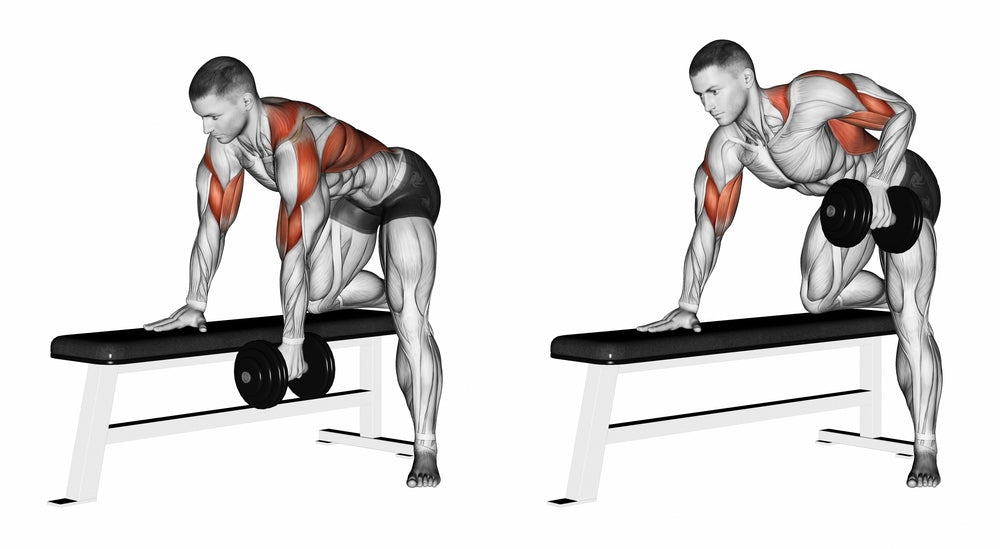
Joint Action and Major Muscles Involved
During the Bent-Over Dumbbell Row with a neutral grip, the primary joint action involves shoulder adduction and extension as the arms pull the dumbbells towards the body. This movement primarily targets the latissimus dorsi, rhomboids, and middle trapezius, fostering upper back development. Additionally, the rear deltoids, biceps, and forearm muscles play a supporting role in the pulling motion. The neutral grip, with palms facing each other, adds a unique aspect to the exercise, emphasizing different areas of the back and enhancing overall muscle balance and strength.
Exercise Execution
Starting Position
Stand with feet approximately shoulder-width apart while holding a dumbbell in each hand. Hinge forward at the hips while maintaining a neutral spine until the torso is inclined forward. Allow the arms to extend toward the floor with the palms facing each other. Keep a slight bend in the knees and engage the core muscles to stabilize the torso.
Movement
Initiate the row by driving the elbows upward and slightly back while keeping them close to the sides of the body. The shoulder blades retract as the dumbbells move toward the lower rib cage. Maintain a stable torso position throughout the pull.
Finish
Lower the dumbbells in a controlled manner until the arms are fully extended. Avoid allowing the shoulders to collapse forward at the bottom of the movement. Repeat while maintaining consistent spinal alignment and controlled tempo.
Exercise Execution Video
Safety Considerations
The primary safety consideration in the Bent-Over Dumbbell Row is maintaining stable spinal alignment throughout the movement. The exercise begins with a hip hinge, not a bend through the waist, allowing the torso to lean forward while the spine remains neutral. A slight bend in the knees and active engagement of the core muscles help stabilize the pelvis and lower back.
During the rowing motion, the torso should remain steady rather than rising or rotating. Pull the dumbbells by driving the elbows upward and back while keeping them close to the body. Avoid using momentum or jerking the weights, as rapid movement can place unnecessary stress on the lower back and shoulder joints.
Control should be maintained through both the lifting and lowering phases of the row. A deliberate tempo allows the back muscles to perform the work while reducing the likelihood of compensatory movement patterns that may increase injury risk.
Exercise Tips
Maintain Proper Torso Position
Keep a flat back and hinge through the hips rather than bending through the waist. A stable torso position helps ensure the back musculature performs the primary work while reducing unnecessary stress on the lower back.
Use a Full Range of Motion
Allow the dumbbells to hang directly beneath the shoulders in the starting position, then pull them toward the lower rib cage or hip area. A complete range of motion encourages stronger activation of the upper back muscles.
Select an Appropriate Load
Use a weight that allows controlled movement while maintaining proper spinal alignment. Excessive loading often leads to torso movement or momentum that reduces the effectiveness of the exercise.
Focus on Elbow Movement
Drive the elbows upward and slightly back rather than pulling with the hands. This cue naturally improves engagement of the latissimus dorsi, rhomboids, and middle trapezius.
Maintain Consistent Breathing
Inhale during the lowering phase and exhale as the dumbbells are pulled upward. Coordinated breathing helps maintain torso stability throughout the movement.
Bent-over dumbbell row vs the seated row
Both the Bent-Over Dumbbell Row and the Seated Row train the muscles responsible for horizontal pulling, including the latissimus dorsi, rhomboids, and middle trapezius. The primary difference between the two exercises lies in how the body stabilizes the movement.
The Bent-Over Dumbbell Row is performed from a hinged standing position, requiring the lifter to maintain spinal alignment while stabilizing the torso with the core and hip musculature. Because the body must support its own position, this variation integrates the back muscles with the stabilizing muscles of the lower body and trunk.
The Seated Row is typically performed using a cable or machine while the body is supported in a seated position. External support reduces the stabilization demands placed on the torso, allowing the lifter to focus more directly on the pulling movement of the upper back.
Another distinction is range of motion and movement freedom. With dumbbells, the arms move independently and can follow a natural path toward the torso, which may allow slightly greater freedom of movement. Machine or cable rows guide the movement along a fixed or consistent path, which can provide more controlled resistance.
Both exercises are valuable horizontal pulling movements. The bent-over row emphasizes integrated body stabilization, while the seated row provides a more supported environment for isolating the upper back muscles.

Continue Your Exercise Education
Mastering exercise technique requires a deeper understanding of biomechanics, injury prevention, and precise movement cues.
The KinX Learning Ultimate Guide series provides structured analysis of 75 popular weight training exercises, helping you train with greater confidence, efficiency, and safety.
Explore the complete system:
Exercise Anatomy and Biomechanics: Ultimate Guide
Exercise Safety and Injury Prevention: Ultimate Guide
Exercise Cues: Precision Coaching for 75 Essential Exercises
Or get all three guides together with the Ultimate Guides Bundle.