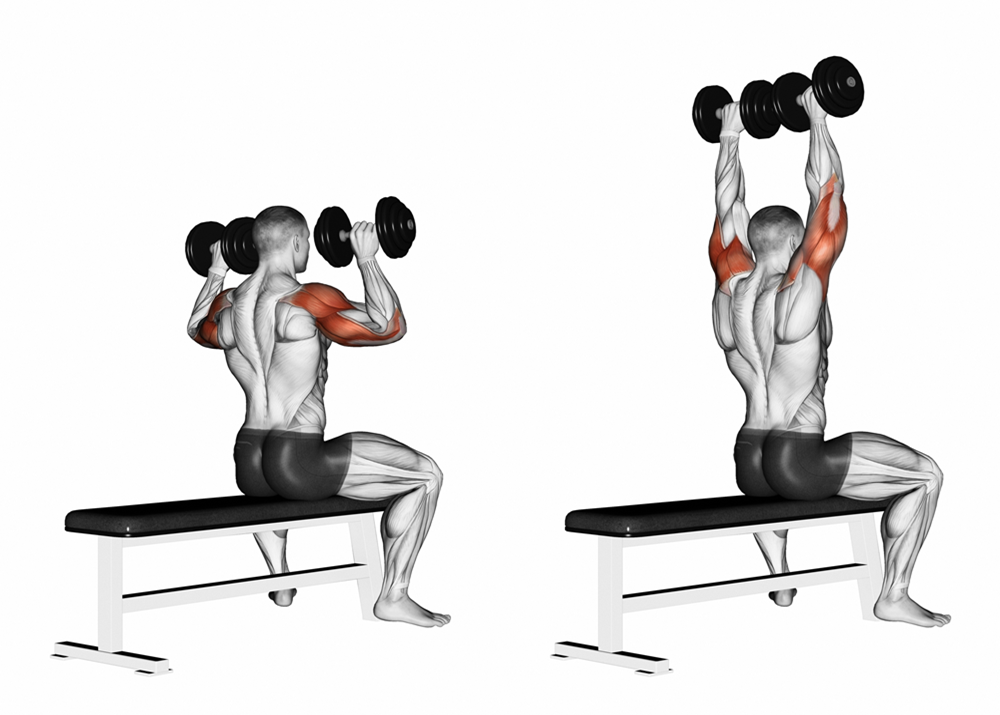
The seated overhead dumbbell press is one of the most effective upper-body exercises for developing shoulder strength, pressing mechanics, and upper-body stability. Unlike machine-based pressing exercises, the use of dumbbells requires each arm to move independently while maintaining control throughout the movement.
Understanding the anatomy and biomechanics involved in the seated overhead dumbbell press can help improve exercise effectiveness, movement quality, and overall shoulder function.
Primary Joint Actions During the Seated Overhead Dumbbell Press
The seated overhead dumbbell press primarily involves:
- Shoulder abduction
- Shoulder flexion
- Elbow extension
- Scapular stabilization
These joint actions work together to move the dumbbells overhead while maintaining stability throughout the shoulder complex.
Prime Movers Involved in the Seated Overhead Dumbbell Press
Anterior Deltoid
The anterior deltoid contributes significantly to shoulder flexion during the pressing movement.
This muscle helps move the upper arm upward while assisting with shoulder stabilization throughout the exercise.
Lateral Deltoid
The lateral deltoid plays an important role in shoulder abduction during the press.
Proper activation of the lateral deltoid contributes to shoulder development and pressing control.
Triceps Brachii
The triceps brachii are responsible for elbow extension during the upward phase of the movement.
These muscles help drive the dumbbells overhead while contributing to overall pressing strength.
Importance of Shoulder Stability
Shoulder stability is a critical component of the seated overhead dumbbell press.
Because each arm moves independently, the shoulders must maintain control throughout the range of motion. Proper stabilization helps support efficient force transfer while promoting controlled movement patterns.
Maintaining a stable shoulder position throughout the exercise can help improve movement quality and exercise effectiveness.
Torso Positioning and Pressing Mechanics
Proper torso positioning contributes to effective pressing mechanics.
Important considerations include:
- Maintaining a neutral spine
- Keeping the chest elevated
- Avoiding excessive lumbar arching
- Maintaining controlled movement throughout the press
Proper positioning helps create a stable foundation for force production while supporting efficient shoulder movement.
Controlled Range of Motion
The seated overhead dumbbell press should be performed through a controlled range of motion that allows the shoulders to move naturally while maintaining stability.
Using controlled movement rather than momentum can help improve muscle activation and overall exercise effectiveness.
The Exercise Classroom
The Exercise Classroom focuses on anatomical, biomechanical, and practical exercise education designed to improve movement understanding and exercise execution.
The seated overhead dumbbell press lesson explores:
- exercise execution
- prime movers
- muscle mechanics
- biomechanical considerations
- shoulder stability
- safety and injury prevention
- proper pressing technique
Related Content
Seated Overhead Dumbbell Press Exercise Page
The Exercise Classroom: Seated Overhead Dumbbell Press
Learn More
Learn More @ KinX Learning
Anatomical, Biomechanical and Practical Exercise Education
kinxlearning.com