
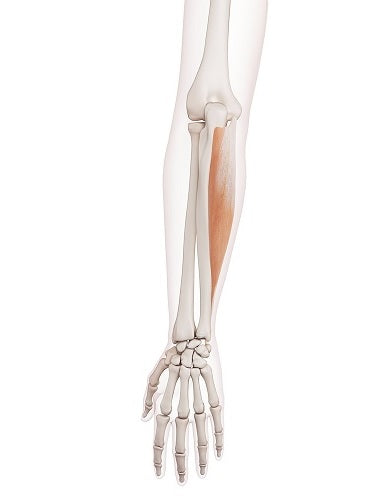
Muscle Anatomy
flexor carpi ulnaris
The flexor carpi ulnaris muscle is located in the anterior compartment of the forearm, forming part of the muscles responsible for flexing the wrist. It is a long and slender muscle with a fusiform shape.
Origin:
Originating from the medial epicondyle of the humerus and the posterior border of the ulna, the flexor carpi ulnaris takes its starting point from the bony structures on the inner side of the elbow and the ulna.
Insertion:
The muscle inserts into the pisiform bone, the hook of the hamate, and the base of the fifth metacarpal bone. Additionally, it has an aponeurotic insertion into the pisohamate ligament. This insertion site establishes a connection with the bones of the hand.
Function:
Functionally, the flexor carpi ulnaris is a powerful flexor of the wrist joint. It is actively involved in bringing the hand closer to the anterior aspect of the forearm, contributing to wrist flexion. Additionally, the muscle plays a role in ulnar deviation of the hand, where the hand moves toward the pinky side. The flexor carpi ulnaris is important in various activities requiring precise control of the hand and wrist, such as gripping objects and performing fine motor tasks. It is part of the group of muscles that contribute to the overall dexterity and functionality of the hand and wrist.
flexor carpi ulnaris
Related Exercises
Best Exercises for the Flexor Carpi Ulnaris
The flexor carpi ulnaris is responsible for wrist flexion and ulnar deviation, contributing to grip strength and forearm stability.
Primary Isolation Exercises
Wrist Curl (Wrist Flexion)
Supporting Movements
Biceps Curl with a Barbell
Pull-up
Chin-Up
How to Emphasize the Flexor Carpi Ulnaris
Focus on controlled wrist flexion with slight ulnar movement
Maintain stable forearm positioning throughout the exercise
Avoid excessive wrist deviation that reduces targeted activation
Control both the lifting and lowering phases to maintain tension
Explore Exercise Technique and Execution
Each exercise listed above includes a full breakdown of proper form, muscle involvement, biomechanics, and safety considerations. Select an exercise to learn how to train the forearm muscles effectively.