
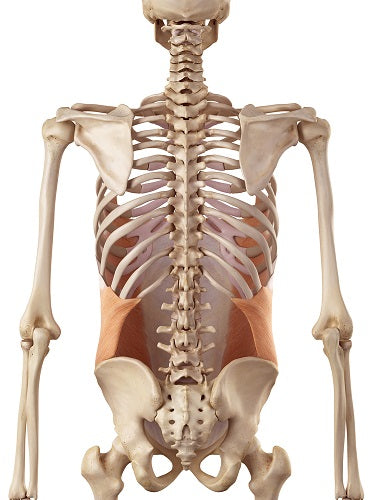
Muscle Anatomy
external oblique
The external oblique muscles are situated in the lateral and anterior abdominal wall, forming part of the muscles that contribute to the core. They are broad, flat muscles with fibers running at an oblique angle.
Origin:
Originating from the external surfaces of the lower eight ribs, the external oblique takes its starting point from the bony structures of the ribcage.
Insertion:
The muscle inserts into the linea alba, the iliac crest, and the pubic tubercle. Additionally, it has some fibers that blend with the aponeurosis of the rectus abdominis. This insertion site establishes connections with the midline of the abdomen, the pelvic region, and the iliac crest.
Function:
Functionally, the external oblique plays a crucial role in the movements of the trunk and contributes to core stability. Bilateral contraction of these muscles results in flexion of the trunk, bringing the chest closer to the pelvis. Unilateral contraction facilitates lateral flexion and rotation of the trunk. Additionally, the external oblique is involved in forced expiration, as it compresses the abdominal contents, increasing intra-abdominal pressure. During activities such as bending, twisting, or maintaining an upright posture, the external oblique works synergistically with other abdominal muscles to provide support, stability, and contribute to
external oblique
Related Exercises
Best Exercises for the External Obliques
The external obliques are responsible for trunk rotation and lateral flexion, playing a key role in rotational movements and core stability. Exercises that emphasize controlled twisting and side bending are most effective for targeting this muscle.
Primary Isolation Exercises
Side Bend
Supporting Movements
Sit-Up (Curl-Up)
Reverse Sit-Up
How to Emphasize the External Obliques
Focus on controlled trunk rotation or lateral flexion during each repetition
Maintain tension through the sides of the abdomen rather than the hips
Avoid excessive momentum when performing twisting movements
Control both the movement and return phases to maintain engagement
Explore Exercise Technique and Execution
Each exercise listed above includes a full breakdown of proper form, muscle involvement, biomechanics, and safety considerations. Select an exercise to learn how to train the core effectively.